
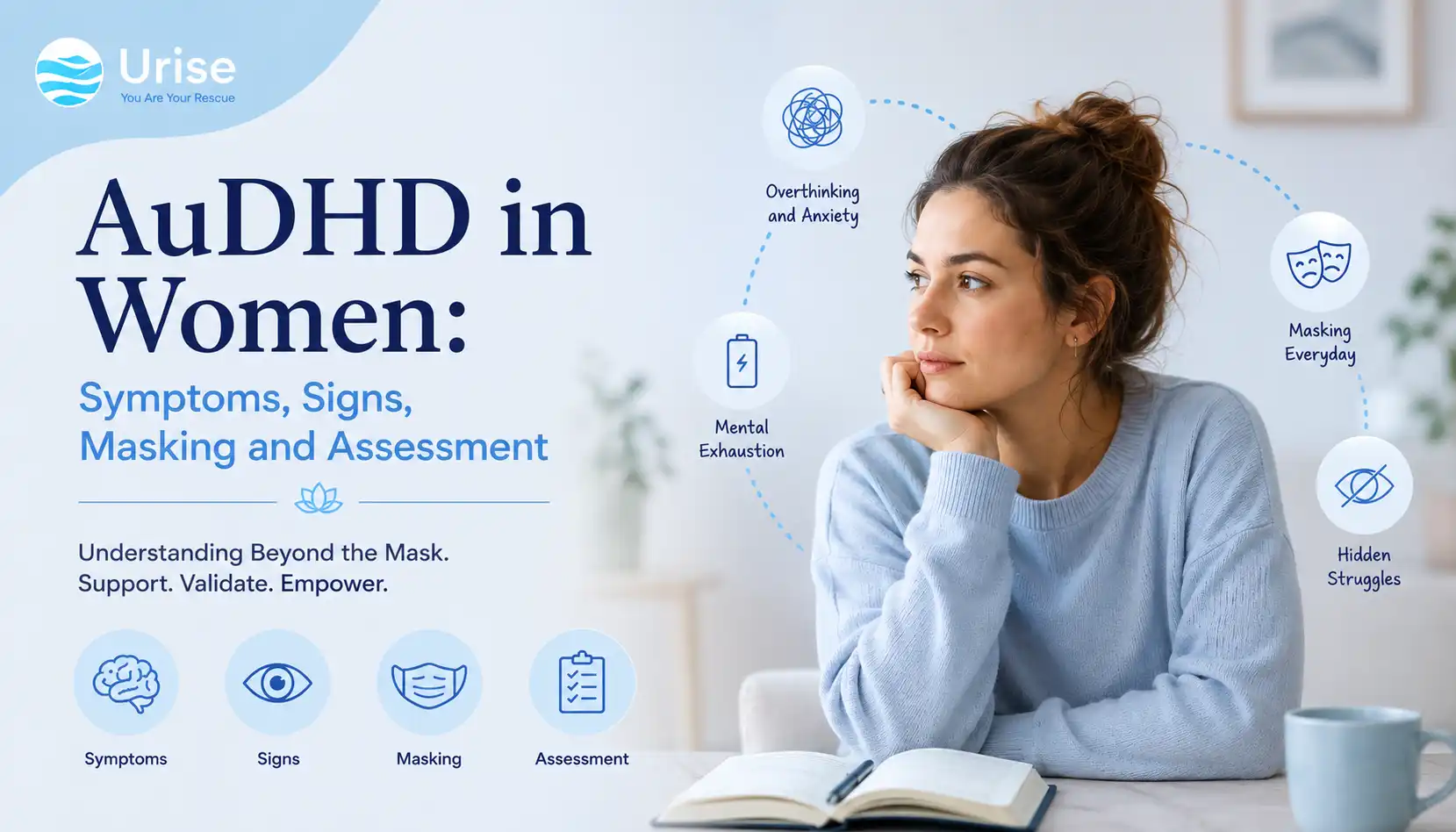
AuDHD refers to having both autism and ADHD. It is not a formal diagnosis, but a term used to describe this combination. In women, AuDHD can be hard to recognise because masking may hide traits, while autism and ADHD can sometimes overlap or balance each other out.
Many women only recognise these patterns in adulthood, especially after years of being told they have anxiety or depression. This guide explains AuDHD in women, common signs, why it is often missed, assessment, and available support.
What Is AuDHD?
AuDHD is a term used when a person has both autism and ADHD. It is not a separate medical diagnosis, but a shorthand for the co-occurrence of autism and ADHD. Having both can create a pattern of traits that may look different from autism or ADHD alone.
Autism may involve differences in social communication, sensory processing, and a need for predictability. ADHD may affect attention regulation, impulse control, motivation, and executive functioning. When both occur together, these traits can interact rather than simply add up.
For example, a person with AuDHD may want a predictable routine but struggle to follow it consistently. They may enjoy familiar environments but also become restless when things feel repetitive. These seemingly opposite behaviours can make AuDHD difficult to recognise, but they can make sense when both autism and ADHD are present.
AuDHD Symptoms in Women
AuDHD does not look identical in every woman. Personality, environment, coping strategies, and the amount of masking someone has learned can all affect how traits appear.
Masking and Social Exhaustion
Masking means hiding or suppressing natural autistic or ADHD traits to fit social expectations, such as copying social behaviours, rehearsing conversations, monitoring facial expressions and body language, or hiding discomfort. A woman may appear confident and comfortable while using significant mental effort to manage the interaction, which can leave her socially exhausted, disconnected, or struggling in relationships over time.
Executive Dysfunction and Task Paralysis
Executive functioning involves mental processes used to start tasks, prioritise, organise information, remember steps, and switch between activities. When these processes are affected, ordinary tasks can become surprisingly difficult.
Someone might complete a complicated project with intense focus but then struggle to answer an email, start household chores, or complete another simple task. This inconsistency can be frustrating, particularly when other people interpret it as laziness or a lack of effort.
Hyperfocus and Special Interests
AuDHD can involve intense focus on particular subjects or activities. In an autistic context, this may involve special interests, while ADHD can involve strong interest-based attention. These experiences are not identical, but they can overlap.
A person may become deeply absorbed in something they find interesting and lose track of time, food, sleep, or other responsibilities. This can be enjoyable and productive, but difficulty shifting attention can also make everyday responsibilities harder to manage.
Sensory Overload and Sensory Processing Differences
Sensory differences are common in autism and can also occur in ADHD. Noise, bright lights, textures, strong smells, or crowded environments may feel more intense than expected.
Sensory overload can build gradually, particularly when someone is already tired or dealing with multiple demands. By the time the person notices what is happening, they may already need to withdraw from the situation.
Emotional Dysregulation
Some women with AuDHD describe strong emotional reactions, difficulty regulating feelings in the moment, and needing longer to return to their usual state after stressful experiences.
Emotional dysregulation is not unique to AuDHD and is not enough to establish a diagnosis. However, when it occurs alongside attention difficulties, sensory differences, masking, and other long-standing patterns, it may form part of the overall picture.
Burnout and Energy Crashes
Another pattern can involve periods of intense effort or productivity followed by significant exhaustion and reduced functioning. Masking, sensory demands, executive-function difficulties, and prolonged stress can all contribute.
Repeated cycles of pushing through difficulties and then needing substantial recovery time can affect work, relationships, routines, and general wellbeing.
What Does AuDHD Look Like in Adult Women?
The way AuDHD appears can become easier to understand when viewed across everyday situations.
At work
A woman may become extremely productive close to a deadline but struggle with routine administrative work. She may rely heavily on calendars, reminders, lists, or other systems to compensate for difficulties with organisation and memory. Maintaining a socially acceptable persona throughout the working day can also leave her exhausted.
At home
She may go through periods of intense organisation followed by difficulty maintaining the same systems. Several small demands arriving at once can create task paralysis, even when each individual task seems manageable.
In relationships
She may want connection while also finding social interaction tiring. Misunderstandings, difficulty managing expectations, or differences in communication style may create additional strain. These experiences can sometimes overlap with broader communication issues in relationships.
In daily routines
She may want predictability in some areas but crave novelty in others. Unexpected changes, transitions between activities, and routines that are difficult to maintain can all become sources of frustration.
These are patterns rather than a checklist. Not every woman with AuDHD will experience all of them.
Autism and ADHD Overlap in Women
Autism and ADHD share some features, which can make them difficult to distinguish. When both occur together, the interaction between them can create additional challenges.
| Area | Autism | ADHD | AuDHD |
| Attention | Deep focus on specific interests | Attention may shift toward novelty | Intense focus with difficulty on non-preferred tasks |
| Routine | Often a preference for predictability | May struggle to maintain routines | May want structure but struggle to follow it |
| Novelty | May be less focused on seeking novelty | Often seeks stimulation | May want both predictability and novelty |
| Social interaction | Differences in social communication | May involve impulsivity or oversharing | May mask heavily while feeling socially exhausted |
| Sensory processing | Common autistic feature | Can also occur | Sensory demands may become harder to manage |
| Executive function | Can affect flexibility and switching | Often affects initiation and organisation | Difficulties from both can overlap |
| Transitions | May be difficult | Attention shifting may be difficult | Switching activities may be particularly challenging |
This table is a general guide rather than a diagnostic tool.
Why AuDHD Is Often Missed in Women
Masking Can Hide Symptoms
Masking can make genuine difficulties difficult for teachers, doctors, employers, friends, and family members to recognise. A woman may appear organised, sociable, responsible, or capable while using significant effort to maintain that appearance.
The result can be a large difference between how someone appears externally and how much effort everyday life requires internally.
Autism and ADHD Can Mask Each Other
Traits from one condition can sometimes obscure traits from the other. A strong reliance on routines may compensate for ADHD-related organisation difficulties. ADHD-related social energy may also make autistic social differences less obvious to other people.
Similarly, intense preparation or hyperfocus may make someone appear highly organised in certain situations, even when maintaining everyday organisation remains difficult.
Gender Expectations and Social Conditioning
Many women grow up with strong expectations around being organised, managing emotions, maintaining relationships, and meeting household or workplace responsibilities.
These expectations can encourage masking and people-pleasing behaviours. Someone may become very skilled at appearing capable while receiving little recognition for the effort required to maintain that appearance.
Misdiagnosis and Self-Diagnosis
AuDHD traits can overlap with anxiety, depression, stress, and burnout. This means some women receive an explanation for part of their difficulties without recognising the wider pattern.
For example, long-term overwhelm can be associated with anxiety, while prolonged difficulties with motivation, energy, and daily functioning may also overlap with depression.
These conditions can also genuinely occur alongside autism and ADHD, so receiving an anxiety or depression diagnosis does not automatically mean it was incorrect.
Recognising yourself in AuDHD content online can be a useful starting point for further questions, but identifying with a collection of traits is not the same as receiving a diagnosis.
Why Some Women Recognise AuDHD After 30
Awareness of autism and ADHD in women has increased, making information about adult presentations easier to find. Years of masking can also become harder to maintain as responsibilities increase.
Work demands, parenting, relationships, and major changes in daily life can remove routines that previously helped someone cope. A woman may then notice difficulties that were present for years but had previously been managed through structure, effort, or support from her environment.
Some women also look back at childhood and recognise patterns they did not have words for at the time. An earlier explanation such as anxiety or depression may have described some experiences without accounting for lifelong attention, sensory, social, or executive-function differences.
Hormonal changes may also affect how existing traits are experienced, although hormones do not cause autism or ADHD.
Hormones and AuDHD in Women
Hormonal changes during the menstrual cycle, pregnancy, the postpartum period, perimenopause, and menopause may influence how ADHD and autistic traits are experienced.
Research into the relationship between ADHD symptoms and sex hormones is still developing. It is more accurate to view hormonal changes as something that may affect the intensity or management of existing traits rather than as a cause of autism or ADHD.
Strengths of AuDHD
Difficulties are only one part of the picture. Some women with AuDHD describe strengths such as creative problem-solving, pattern recognition, deep interests, curiosity, strong personal values, and intense focus.
These strengths can exist alongside genuine difficulties. For example, intense focus may help someone produce excellent work in an area they care about while making it difficult to switch to less interesting tasks.
The experience is different for every person, so strengths should not be treated as universal features of AuDHD.est. Having several of these experiences does not automatically mean someone is autistic and has ADHD. It can, however, provide a reasonable basis for discussing an assessment.
AuDHD Assessment: What Happens?
An AuDHD assessment usually involves assessing for both autism and ADHD because they have different diagnostic criteria. It may include an initial consultation, developmental history including childhood traits and experiences, current difficulties, and how these affect daily life, work, education, relationships, and routines.
A qualified clinician may also consider other possible explanations for these difficulties. Assessing for both conditions can provide a clearer picture when traits overlap or make one condition harder to recognise.
After the assessment, the clinician explains the findings and discusses possible next steps.
What Support Can Help With AuDHD?
Support for AuDHD should match the person’s needs. Helpful strategies may include using reminders, breaking tasks into smaller steps, creating helpful routines, reducing sensory overload, and communicating needs clearly. Reasonable adjustments at work or school and less pressure to mask may also make everyday life easier.
Professional support can also be considered. Depending on individual needs, this may include therapy, coaching, or other clinical support. Different approaches may be useful for different concerns, which is why understanding the types of therapy available can be helpful when considering support.
Frequently Asked Questions About AuDHD
What are the symptoms of AuDHD in women?
Common patterns include masking, social exhaustion, executive-function difficulties, hyperfocus, sensory differences, emotional dysregulation, and recurring burnout. Not every woman experiences all of these.
What does AuDHD look like in adult women?
It may involve intense productivity followed by exhaustion, difficulty maintaining routines, wanting social connection while finding it tiring, and relying on systems that are difficult to maintain.
What’s different about autism and ADHD in women?
Women may mask more consistently because of social expectations, while autism and ADHD traits can also obscure each other. This can make AuDHD harder to recognise.
Can people with AuDHD feel overwhelmed?
Yes. Combined sensory, social, emotional, and executive demands can become difficult to manage, particularly during prolonged stress or periods of heavy masking.
How do sensory processing differences affect women with AuDHD?
Noise, light, textures, smells, and crowded environments may feel more intense. Sensory overload can build gradually before someone realises they have reached their limit.
Is AuDHD the same as ADHD?
No. AuDHD refers to autism and ADHD occurring together, rather than ADHD alone.
Is there a test for AuDHD?
There is no single AuDHD test. An assessment generally involves evaluation of autism and ADHD, developmental history, current difficulties, and consideration of other possible explanations.
A Quick Recap
AuDHD means having both autism and ADHD. In women, masking can hide the signs and lead to late recognition. If these patterns feel familiar, a professional assessment can help you understand what you’re experiencing and find the right support