
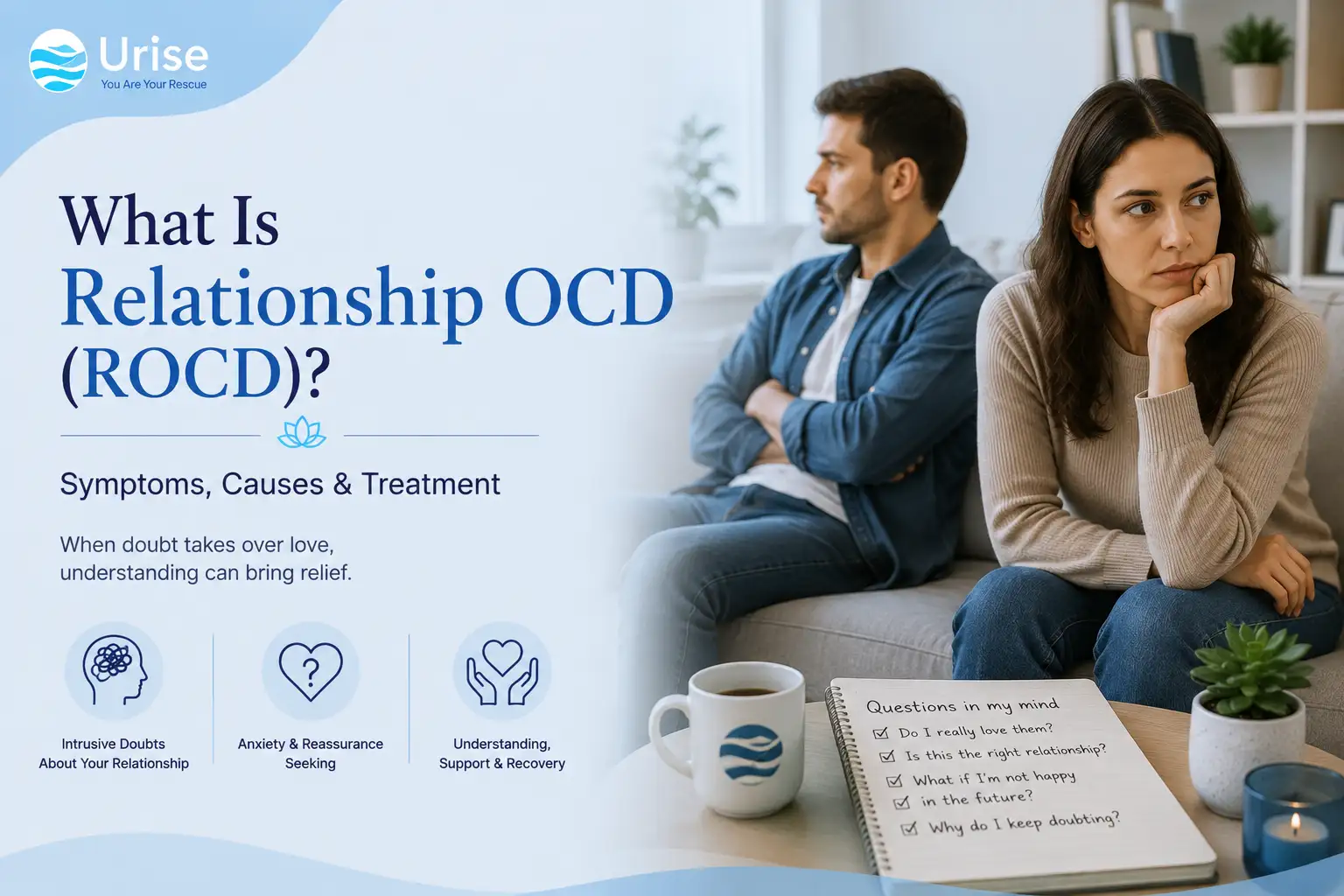
Relationship OCD refers to obsessive-compulsive symptoms that centre on a romantic or intimate relationship. It can involve persistent doubts, intrusive thoughts, and anxiety about love, attraction, compatibility, or a partner’s qualities, along with compulsive attempts to find certainty, such as checking, comparing, or seeking reassurance.
Ordinary relationship uncertainty differs from this pattern. It becomes more like ROCD when doubts feel persistent, hard to let go of, and lead to repeated compulsions rather than passing naturally. This article covers what ROCD looks like, its symptoms, how it affects relationships, what may contribute to it, and how it is treated.
What Does Relationship OCD Look Like?
Researchers, including Doron and colleagues at the International OCD Foundation, describe ROCD as showing up in two main ways.
Relationship-Centred ROCD
Doubts focus on the relationship itself. Common thoughts include: Do I really love my partner enough? Is this the right relationship? Are we compatible? Should I feel more certain than I do? What if I’ve made the wrong choice?
Partner-Focused ROCD
Doubts focus more on the partner’s specific qualities, such as their appearance, personality, intelligence, habits, or other perceived flaws. Many people experience a mix of both types, and having occasional doubts about a partner does not by itself mean someone has ROCD.
What Are the Symptoms of ROCD?
ROCD symptoms generally fall into obsessions and compulsions. Common obsessions include repeated doubts about love, questioning attraction or compatibility, fear of being with the wrong person, worrying someone else might be a better match, fixating on a partner’s perceived flaws, worries about commitment, and persistent fears about whether the relationship feels “right.”
Common ROCD Compulsions
- Reassurance seeking, repeatedly asking a partner, friend, or family member for certainty
- Mental checking of feelings, constantly scanning for signs of love or attraction
- Testing attraction, or comparing a partner with other people
- Researching relationships online or in forums
- Analysing conversations or past events for hidden meaning
- Avoiding intimacy or relationship milestones
- Repeatedly considering breaking up as a way to reduce anxiety
What Is the ROCD Obsession-Compulsion Cycle?
ROCD tends to follow a repeating pattern: an intrusive doubt appears, anxiety builds, the person responds with a compulsion such as checking, reassurance-seeking, or comparing, and this brings brief relief. The relief does not last, and the doubt returns, often more insistently. Over time, compulsions reinforce the need to seek certainty again, which is part of why the cycle can feel hard to break without support.
ROCD vs Normal Relationship Doubts: What’s the Difference?
Most people experience some uncertainty in relationships at times. This alone does not indicate ROCD.
| Normal relationship doubt | ROCD | |
| Frequency | Occasional | Repetitive, intrusive |
| Response | Reflection, sometimes discussed with a partner | Compulsive checking, reassurance-seeking, or comparing |
| Relationship to uncertainty | Can tolerate not knowing for certain | Feels driven to eliminate the uncertainty |
| Impact | Passes without major disruption | Causes significant distress or interferes with daily life |
A checklist alone cannot confirm ROCD. Professional assessment may be worth considering when doubts are persistent and interfering with daily functioning.
How Does ROCD Affect Relationships?
ROCD can affect emotional connection, intimacy, and communication, since ongoing doubt makes it harder to feel present with a partner. It can also affect commitment decisions, contribute to conflict, and lead to withdrawal or less time spent together. ROCD symptoms can lower relationship and sexual satisfaction, alongside higher personal distress. The person with ROCD may feel confused or disconnected from their own feelings, while a partner may feel rejected, inadequate, or worn down by repeated requests for reassurance.
Can ROCD Affect the Other Partner?
Yes. Repeated reassurance-seeking can exhaust a partner over time, who may start to feel responsible for constantly proving the relationship is safe. Some partners get drawn into checking or reassurance rituals themselves, without realising this can reinforce the cycle, and often feel confused about why reassurance never resolves the doubt for long. Partners of someone with ROCD may also need their own support and boundaries, separate from the person experiencing symptoms directly.
What Causes Relationship OCD?
There is no single root cause of ROCD, and the underlying causes of OCD more broadly remain complex. Several patterns may be relevant, including intolerance of uncertainty, perfectionistic expectations about what a relationship “should” feel like, an inflated sense of responsibility, and heightened attention to relationship-related uncertainty. The same research has also explored possible links between attachment style and self-esteem, though these appear to be areas of relevance rather than established causes.
How Is Relationship OCD Treated?
Cognitive behavioural therapy (CBT) that includes Exposure and Response Prevention (ERP) is an established, evidence-based treatment for obsessive-compulsive disorder, and NICE guidance recommends CBT with ERP as a first-line treatment. This applies where obsessions and compulsions centre on relationships too. Understanding the benefits of CBT therapy can help explain why it’s so widely used for anxiety and obsessive-compulsive difficulties more broadly. Because ROCD is still relatively under-recognised, it’s worth speaking to a qualified CBT specialist with specific experience in OCD, rather than general relationship advice, to make sure the treatment for relationship OCD actually targets the underlying pattern.
CBT With Exposure and Response Prevention (ERP)
CBT helps identify the thought and behaviour patterns keeping ROCD going, partly through cognitive reappraisal, which means learning to look at an intrusive thought differently rather than treating it as fact. ERP involves gradually facing feared thoughts or situations, such as sitting with uncertainty about a relationship rather than immediately checking or seeking reassurance. Therapists often use behavioural experiments alongside this, testing out what actually happens when a compulsion is resisted, to help build evidence against the fear. Over time, this aims to reduce reliance on compulsions rather than to provide certainty about the relationship itself. This is a gradual process, and it does not guarantee an outcome for every individual.
Acceptance and Commitment Therapy (ACT)
ACT may be used alongside CBT to help someone relate differently to intrusive thoughts, using techniques such as defusion, which means learning to notice a thought without automatically believing or acting on it. Mindfulness is often part of this too, helping build tolerance for uncertainty and supporting someone to act in line with personal values rather than anxiety. ACT is generally used as a complement to established OCD treatment rather than a replacement for it.
Medication
Medication such as an SSRI may be considered for OCD, depending on symptom severity and a full clinical assessment. This is not necessary for everyone, and any decision about medication should be made with a doctor or psychiatrist.
Alongside Wider Relationship Support
Where ROCD has also strained communication or created wider relationship difficulties, relationship therapy may be considered alongside OCD-focused treatment. However, it does not replace ERP for the underlying OCD symptoms.
What Is Retroactive Jealousy in ROCD?
Some people with ROCD experience retroactive jealousy, a fixation on a partner’s past relationships. This can involve repeatedly asking about an ex, comparing yourself to them, or replaying details from before the current relationship began. Like other ROCD compulsions, this tends to bring only short-lived relief and often leaves both partners feeling more distant.
How Can You Support a Partner With ROCD?
Learning about the ROCD cycle together can help make sense of what’s happening. It generally helps to avoid repeatedly giving reassurance or taking part in checking and comparison rituals, since this can unintentionally keep the cycle going. Encouraging professional support, without pressure, tends to help more than trying to resolve the doubts yourself. Setting clear boundaries and looking after your own wellbeing matters too. Responding with empathy, without trying to prove that every doubt is false, tends to help more than constant reassurance. Repeated reassurance-seeking and avoidance can also contribute to wider communication issues in relationships, particularly when one partner feels responsible for repeatedly proving the relationship is secure.
When Should You Seek Help for ROCD?
Professional support may be worth considering when relationship doubts take up significant time, compulsions happen frequently, symptoms interfere with work or daily life, intimacy is affected, or the relationship is repeatedly disrupted by checking or reassurance-seeking. If the distress feels persistent and hard to manage alone, that is a reasonable signal to reach out for support.
Frequently Asked Questions
How do you tell if you have ROCD?
A checklist alone can’t confirm it. The clearest signal is whether doubts and checking behaviours are taking up significant time, causing real distress, or getting in the way of daily life, rather than passing on their own. A professional assessment is the most reliable way to know for sure.
How do people with OCD act in a relationship?
Someone with ROCD may frequently ask for reassurance, mentally check their own feelings, compare their partner to others, avoid intimacy or milestones, or withdraw during moments that would normally feel close, even when the relationship itself is going well.
Can ROCD make you want to break up?
Some people with ROCD experience urges to end the relationship as a way to escape anxiety and uncertainty. These urges are part of the compulsive pattern rather than necessarily reflecting how someone actually feels about their partner.
Can a relationship survive ROCD?
Yes, many relationships continue and improve once ROCD is properly understood and treated. The doubts driving ROCD come from the OCD pattern itself rather than a genuine problem with the relationship, which is part of why treatment focused on the compulsions, rather than trying to resolve every doubt, tends to help.
How do you get rid of ROCD?
There is no instant fix, but CBT with ERP is an established, evidence-based approach, and some people also find ACT or medication helpful as part of a wider treatment plan. Recovery is usually gradual and depends on the individual.