
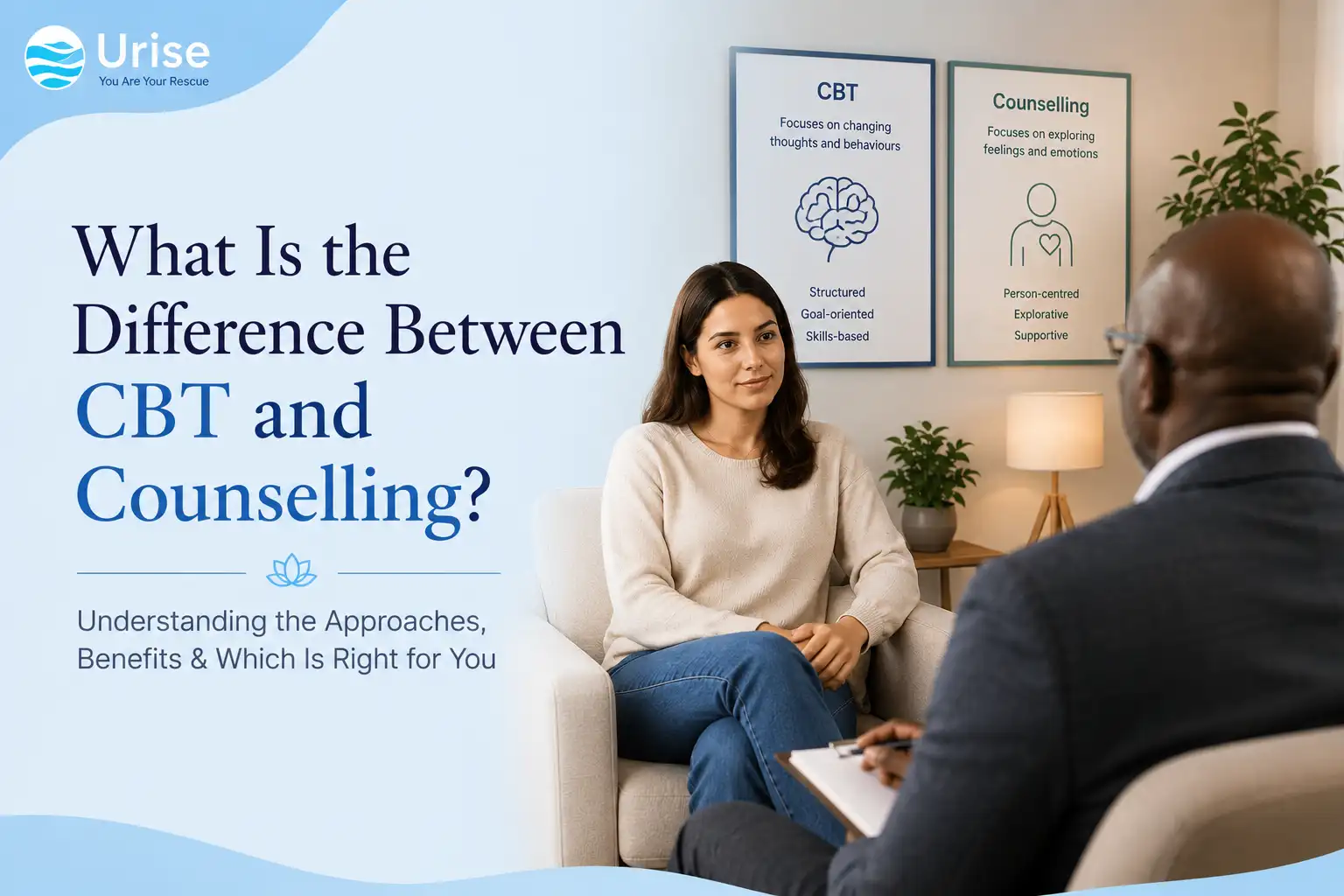
CBT and counselling are both talking therapies, but they work in different ways. CBT, or cognitive behavioural therapy, is structured and goal-oriented, focused on changing specific patterns in your thoughts and behaviour. Counselling is more open-ended, focused on exploring feelings and experiences without a fixed programme. This guide covers how each one works, what they can help with, where they differ, and how to decide which one fits what you need right now.
CBT vs Counselling
| CBT | Counselling | |
| Focus | Current thoughts and behaviours | Feelings, experiences, self-understanding |
| Structure | Structured, goal-oriented | Open-ended, exploratory |
| Typical length | Short-term, often 6 to 20 sessions | Can be short-term or ongoing |
| Therapist’s role | Active, teaches specific techniques | Supportive, mostly non-directive |
| Homework between sessions | Common | Rare |
| Best suited for | A specific, defined problem | Broader emotional support or life difficulties |
| NHS availability | Widely available through NHS Talking Therapies | Some availability, more often accessed privately |
What Is CBT?
CBT is a structured talking therapy built on the idea that thoughts, feelings, and behaviours are all connected. Changing one can shift the others. A CBT therapist works with you to spot unhelpful thought patterns and replace them with more balanced ones.
How CBT Works
Sessions usually start with setting a clear, specific goal. From there, the therapist helps you notice patterns in your thinking, using structured techniques rather than open conversation alone. This might include tracking negative thoughts, testing them against evidence, or gradually facing situations you have been avoiding. NICE guidance recommends CBT as a first-line treatment option for generalised anxiety disorder, which is part of why it is so widely offered through the NHS.
What Can CBT Help With
CBT has strong evidence behind it for anxiety disorders, depression, phobias, obsessive-compulsive disorder, and panic disorder. It is also used for insomnia and some physical health conditions where thoughts and behaviour play a role in symptoms. For adult ADHD, research suggests CBT can help, though it usually needs to be adapted specifically for ADHD-related difficulties to be genuinely useful, rather than delivered in its standard form.
What Happens During a CBT Session
A typical session runs around fifty minutes. Early sessions focus on identifying the problem and setting goals. Later sessions work through specific techniques, and you will often leave with homework, such as a thought record or a small exercise to try before the next session. A full course is usually somewhere between 6 and 20 sessions, depending on the issue.
What Is Counselling?
Counselling is a broader talking therapy, focused on providing a supportive space to explore feelings, experiences, and personal difficulties. It does not always aim at a specific, measurable outcome, and it covers many different approaches, from person-centred to psychodynamic to integrative.
How Counselling Works
Most counselling is non-directive. Rather than following a set structure, the client decides what to bring to each session, and the counsellor listens, reflects, and helps them explore it further. The pace and direction are shaped by the client rather than a fixed programme.
What Can Counselling Help With
People turn to counselling for a wide range of reasons: relationship difficulties, grief, stress, low self-esteem, life transitions, or simply wanting space to think things through. Many people don’t have a single, defined problem to solve. Bereavement counselling and couples counselling are common examples of counselling tailored to a specific life situation rather than a diagnosable condition.
What Happens During a Counselling Session
A session typically involves open conversation, with the counsellor listening closely and reflecting back what they hear. There is usually no homework, and no fixed number of sessions decided in advance. Some people attend for a few weeks to work through something specific, while others continue for months as an ongoing space for support.
What Is the Difference Between CBT and Counselling?
Both are talking therapies, but they differ across several dimensions.
Difference in Focus
CBT focuses on current, specific thought and behaviour patterns tied to a defined problem. Counselling focuses more broadly on feelings, experiences, and self-understanding, without necessarily targeting one specific symptom.
Difference in Approach
CBT is structured and technique-based, often following a set sequence across sessions. Counselling is exploratory and reflective, shaped by whatever the client brings each time.
Difference in Therapist Role
A CBT therapist takes an active role, teaching specific skills and guiding you through exercises. A counsellor takes a more supportive, listening role, generally without directing the conversation or offering advice.
Difference in Treatment Goals
CBT works toward a defined, often measurable goal, such as reducing panic attacks or managing intrusive thoughts. Counselling goals tend to be broader, such as feeling more understood, processing a loss, or gaining clarity on a difficult situation.
Difference in Duration
CBT is usually short-term, with a set number of sessions agreed in advance. Counselling can be short-term too, but it is often more flexible, sometimes continuing for months without a fixed end point.
Are CBT and Counselling the Same?
No. CBT is one specific therapeutic approach, with its own structure and techniques. Counselling is a broader term covering many different approaches, of which CBT is technically one. Some counsellors are also trained in CBT and can offer either style, depending on what a client needs.
What Are the Similarities Between CBT and Counselling?
Despite the differences, both approaches share some common ground. Both are delivered by trained, qualified professionals, and both should be confidential. Both rely on a trusting relationship between client and therapist, since this relationship affects how well either approach works. Both can be accessed through the NHS or privately, and both typically involve regular sessions, whether weekly or fortnightly.
CBT Or Counselling: Which Is Better?
Neither is universally better. It depends on what you are looking for.
CBT May Be Suitable If…
- You have a specific, defined problem, such as panic attacks, a phobia, or intrusive thoughts
- You want practical techniques you can apply between sessions
- You prefer a structured approach with clear goals
- You are comfortable doing homework or exercises outside of sessions
- You want a shorter, more time-limited course of therapy
Counselling May Be Suitable If…
- You want space to talk without a fixed agenda
- You are dealing with grief, a life transition, or relationship difficulties rather than one specific symptom
- You prefer to set the pace and direction of sessions yourself
- You are looking for emotional support rather than a structured programme
- You are open to a longer, more flexible timeframe
Can You Have CBT and Counselling Together?
Yes, though not usually for the same issue at the same time with two separate therapists. It is common for people to try one approach first and move to the other if it does not feel like the right fit. Some people also use counselling for broader emotional support while working through a specific issue with CBT elsewhere. The benefits of CBT therapy can make it a useful option for people who prefer a more structured approach to specific thoughts, behaviours, or emotional difficulties. Some integrative counsellors also draw on CBT techniques within an otherwise more open-ended, counselling-style approach.
How To Choose Between CBT and Counselling?
Start by asking what brought you to therapy. If it is a specific, identifiable problem, such as a phobia or panic attacks, CBT’s structured approach is often a good starting point. If what you are dealing with feels broader, such as grief, ongoing stress, or difficulty understanding your own feelings, counselling may fit better.
It also helps to think about how you want sessions to feel. If you want clear techniques and homework, CBT will likely suit you. If you would rather talk things through at your own pace without a fixed structure, counselling is the better fit.
If you are still unsure, BACP-registered therapist can help you work out which approach fits your situation, and many services offer an initial assessment specifically to help match you with the right kind of support.
Frequently Asked Questions
Is CBT better than counselling for anxiety?
CBT has strong research support for anxiety and is recommended as a first-line option in NICE guidance. That said, counselling can still help, particularly where anxiety is closely tied to a specific life situation rather than a standalone condition.
Is counselling better than CBT for depression?
Not necessarily. NICE guidance supports CBT for depression, but counselling, including person-centred approaches, is also offered depending on severity and personal preference. The right choice often comes down to whether you want a structured programme or a more open, exploratory space.
Can counselling and CBT be used together?
Yes, though usually at different times or for different purposes rather than simultaneously for the same issue with two therapists.
How long does CBT or counselling take?
CBT is typically short-term, often between 6 and 20 sessions. Counselling varies more widely, from a few sessions to several months, depending on what you are working through.
Which is better for me, CBT or counselling?
It depends on whether you are dealing with a specific, defined problem or something broader. A defined issue often points toward CBT, while a broader need for support and exploration often points toward counselling.
Is CBT a type of counselling?
In a broad sense, yes. Counselling is the umbrella term for talking therapies, and CBT is one structured approach within that wider field, alongside person-centred, psychodynamic, and integrative counselling.
Final Thoughts
CBT and counselling are both effective talking therapies, but they suit different needs. CBT offers a structured, short-term approach for specific, defined problems, while counselling offers a more open, flexible space for broader emotional support and self-understanding. The right choice depends on what you are dealing with and how you want to work through it, and a BACP-registered therapist can help you decide if you are unsure.