
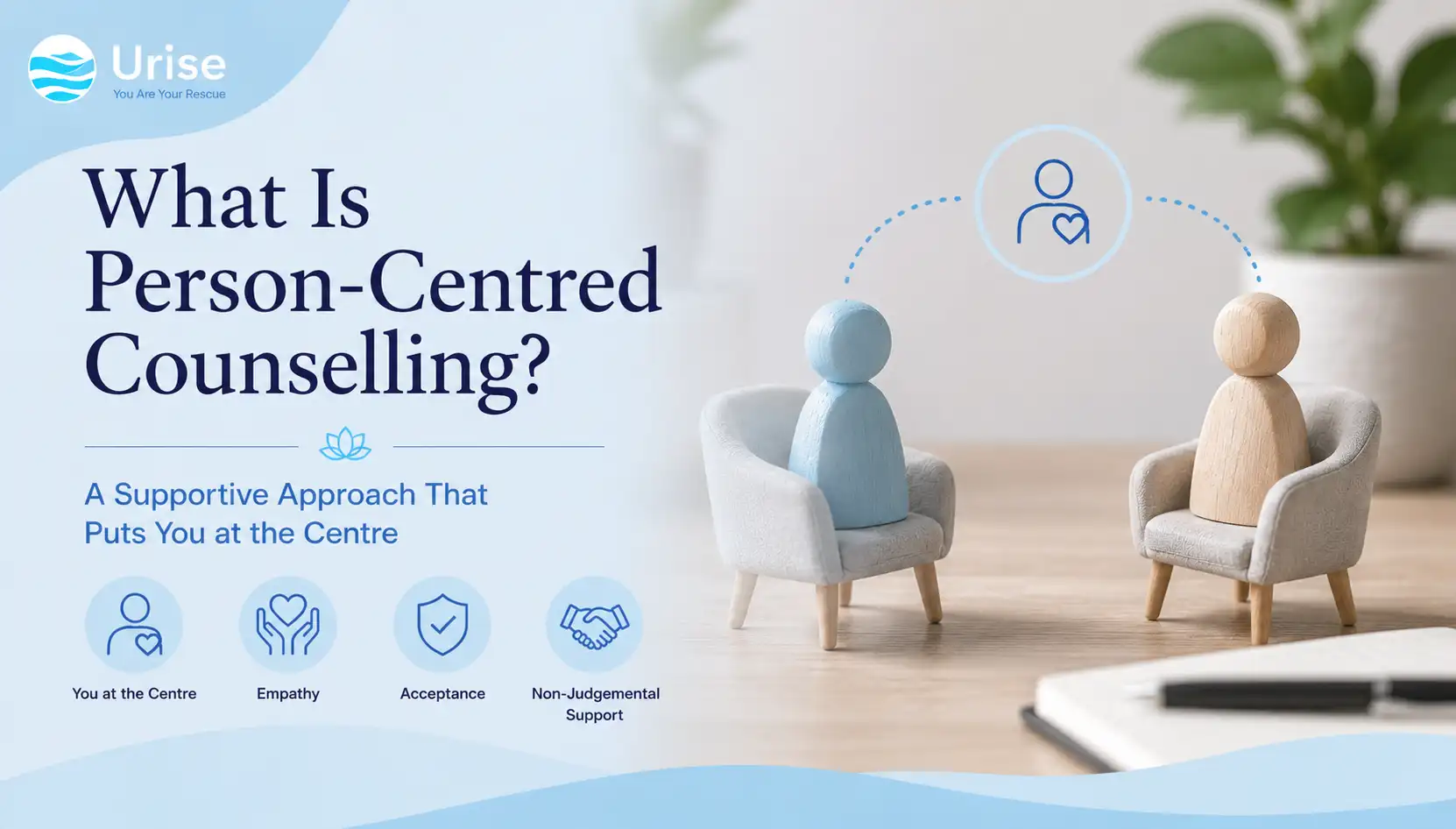
Person-centred counselling is a humanistic type of therapy where the client leads the conversation, not the counsellor. It was developed by the psychologist Carl Rogers, who believed people already hold what they need to understand themselves and grow, given the right kind of support. The counsellor does not diagnose or direct. Instead, they offer a relationship built on three things: empathy, unconditional positive regard, and congruence.
I often explain it this way: the counsellor does not act as an expert on the client’s life. The client is treated as the expert on themselves. This guide covers how the approach works, what the three core conditions mean, what a session looks like, who it tends to suit, and how it compares with other therapies.
How Does Person-Centred Counselling Work?
This approach is called non-directive. The counsellor does not set an agenda, give tasks, or steer the conversation toward a particular answer. The client brings whatever is on their mind, whether that is a clear problem or just a general feeling of unease.
The counsellor’s job is to create space for the client to explore, not to solve the problem for them. This can feel different if you expect therapy to involve advice or a fixed plan. Here, the client sets the pace.
This rests on one core belief: nobody understands the client’s experience, beliefs, or worldview better than the client does. A person-centred counsellor works from that belief, rather than acting like someone who already knows the answer.
Over time, this kind of space tends to support autonomy. Because clients are not being told what to think or do, they are freer to explore their feelings, beliefs, and behaviour without pressure to reach a particular conclusion. This process is often called self-discovery.
What Are the Three Core Conditions?
Carl Rogers believed certain conditions, offered consistently by the counsellor, were enough to support real change. In his 1957 paper, Rogers actually described six conditions in total. Three of these are what the counsellor actively brings to the relationship, and these are the ones usually discussed as the core conditions.
Empathy
Empathy here means more than feeling sorry for someone or agreeing with them. It means the counsellor genuinely trying to understand the client’s experience from the client’s own point of view, without losing sight of the fact that it is not their own experience.
This is sometimes called empathic understanding. A person-centred counsellor listens closely and reflects back what they hear, so the client feels truly understood, not just listened to.
Unconditional Positive Regard
This means the counsellor accepts and values the client without conditions. It does not mean approving of every choice a client makes. It means the client’s worth as a person is never up for judgement, even when what they share feels difficult or shameful.
This matters because fear of judgement often stops people from being honest, even with themselves. When a client feels safe enough to share something difficult, they are often more able to look at it clearly for the first time.
Congruence
Congruence means the counsellor is genuine, not hiding behind a professional mask. It does not mean sharing personal opinions or life details. It means there is no gap between what the counsellor feels and what they communicate.
This matters because it builds trust. A counsellor who is congruent is not performing warmth. They are actually present, which makes it easier for the client to be honest in return.
Why Are These Conditions Important?
Rogers believed these three conditions work together, not alone. Empathy without acceptance can feel hollow. Acceptance without honesty can feel insincere. Together, they build a relationship where the client feels safe enough to be honest, which Rogers believed was enough, on its own, to support real change.
What Is Self-Actualisation in Person-Centred Therapy?
Self-actualisation is a central idea in person-centred therapy. Rogers believed everyone has a natural drive toward growth and becoming more fully themselves, much like a plant grows toward light. He called this the actualising tendency.
This does not mean reaching some fixed idea of success. It means living in a way that reflects your own values and feelings, rather than a version of yourself shaped mainly by other people’s expectations.
Life experience can get in the way of this. Criticism or the sense that love depends on behaving a certain way can push someone away from their own genuine feelings, toward a version of themselves built to please others. Over time, the gap between who someone actually is and who they feel they need to be can cause real distress.
Person-centred counselling aims to remove some of the barriers that block this natural drive. As self-understanding grows, people often become better placed to make choices that genuinely fit who they are.
What Happens During a Person-Centred Counselling Session?
Sessions do not follow a script, but a few patterns are common.
The first session usually covers practical groundwork: confidentiality, how sessions work, and what you hope to get from counselling in general terms. Beyond that, there is no formal assessment or checklist. The client decides what to bring to each session, and this can change week to week.
The counsellor’s role is mostly to listen closely and reflect back what they hear, helping the client hear their own thoughts more clearly. They generally do not give advice, tell the client what to do, or interpret what something “really means.” The relationship is built on trust in the client’s own process.
There is usually no homework. The pace is set by the client, and sessions tend to develop naturally rather than in fixed stages. As trust builds, clients often feel able to bring more difficult material into the room.
What Can You Talk About?
There is no fixed agenda, so clients bring a wide range of topics, including:
- Difficult or confusing feelings
- Relationships, past or present
- Beliefs about themselves or the world
- Patterns of behaviour they want to understand
- Ongoing stress or personal difficulties
- Self-confidence or identity
- Big life experiences
- Goals or decisions they are facing
What Are the Benefits of Person-Centred Counselling?
Person-centred counselling does not promise a fixed outcome, since the process is shaped by the individual. That said, many people who try this approach report certain kinds of change over time.
Clients often develop greater self-awareness, becoming more able to notice their own feelings rather than being swept along by them. Many also describe stronger self-understanding, recognising patterns in how they think or act that were harder to see before.
Some people find this process builds self-confidence, along with a stronger sense of independence in making decisions. Because the counsellor treats the client as capable, clients often begin to trust their own judgement more.
Improved self-acceptance is another common outcome, particularly where unconditional positive regard has helped someone look honestly at parts of themselves they had judged harshly. Over time, this can support broader personal growth and a clearer sense of the resources already available to them.
These are potential outcomes, not guarantees. Every person’s experience of counselling is different, and progress is often gradual.
What Can Person-Centred Counselling Help With?
People seek person-centred counselling for a wide range of concerns, not one specific diagnosis. Common reasons include anxiety therapy, low mood or depression counselling, stress, bereavement counselling, low self-esteem, couples therapy for relationship difficulties, and broader questions around self-worth or identity.
Some people arrive with no clearly defined issue at all. They simply want support to understand feelings or behaviour that feel confusing. Others are drawn to it during a period of change, even without a specific problem to solve.
It is worth separating what people commonly seek this kind of counselling for from what it can be relied on to achieve. Person-centred counselling is not a guaranteed treatment for any specific condition. Suitability depends on the individual, not a fixed list.
Who Might Person-Centred Counselling Suit?
This approach tends to suit people who want space to explore themselves without being steered toward a conclusion. It often appeals to people who prefer a non-directive style, want a strong say in the direction of sessions, and prefer reflection over direct advice.
People who trust their own judgement, want to better understand their own feelings, and see personal growth as an ongoing process rather than a fixed destination, often find this a good fit.
Who Might Prefer a More Structured Approach?
This approach is not right for everyone, and that is not a reflection of anyone’s suitability for therapy in general. Some people prefer structured exercises, a defined treatment plan, or more direct guidance from the therapist. This might include wanting concrete tools for a specific symptom, or a therapist who takes a more active role in shaping each session.
Neither preference is right or wrong. It comes down to what kind of support feels most useful to you right now.
What Is the Theory Behind Person-Centred Counselling?
The practical approach above rests on a theory Carl Rogers developed over several decades.
Carl Rogers and Humanistic Psychology
Carl Rogers was an American psychologist whose work, from the 1940s onward, helped establish humanistic psychology as a distinct field, sometimes called the “third force” alongside psychoanalysis and behaviourism. Where earlier approaches often focused on treating symptoms, Rogers placed personal growth and human potential at the centre of his thinking.
Self-Concept
Self-concept is the overall picture a person holds of who they are, including their beliefs and sense of identity. This picture develops over time, shaped by experiences and feedback from others, especially in childhood.
When self-concept lines up closely with real experience, Rogers believed a person functions well and feels settled. A large gap between the two can cause difficulty.
Conditions of Worth
Conditions of worth describe a pattern where approval from important people feels conditional on behaving a certain way. A child who learns that love depends on being agreeable or high-achieving may start to suppress parts of themselves that do not fit that expectation.
Over time, someone can end up shaping their self-concept around what earns approval, rather than around their own genuine experience. Rogers saw this as a major source of psychological distress.
Locus of Evaluation
Locus of evaluation is about where a person looks for judgement of their own worth or choices. Someone with an external locus of evaluation relies heavily on other people’s approval to know if they are doing well. Someone with an internal locus of evaluation trusts their own judgement more readily.
By offering acceptance without conditions, person-centred counselling aims to support a gradual shift toward a more internal locus of evaluation.
How Is Person-Centred Counselling Different From Other Therapies?
Person-centred counselling shares the same broad goal as most therapy: supporting wellbeing and growth. But it differs in method from other common approaches.
| Approach | Who Leads the Session | Structure | Main Focus |
| Person-centred | Client | Non-directive, no fixed plan | Present feelings and self-understanding |
| CBT | Therapist and client together | Structured, often includes homework | Identifying and changing thought patterns |
| Psychodynamic | Therapist guides interpretation | Less structured, but interpretive | Unconscious processes and past experience |
| Integrative | Varies by therapist | Combines techniques from multiple approaches | Tailored to the individual client |
Person-centred vs CBT. CBT is more structured and directive, often involving set techniques and homework between sessions. Person-centred counselling has no fixed structure, and the counsellor does not direct the client toward particular thoughts. Neither is universally better. CBT suits people who want a focused, skills-based approach to specific symptoms. Person-centred counselling suits people who want open-ended space for exploration.
Person-centred vs psychodynamic therapy. Psychodynamic therapy focuses heavily on unconscious processes and childhood experience, often interpreted by the therapist. Person-centred counselling stays focused on the client’s present experience, guided entirely by what the client chooses to bring.
Person-centred vs integrative counselling. An integrative counsellor deliberately blends techniques from several approaches. A person-centred counsellor works within the person-centred framework specifically, relying on the core conditions rather than mixing in other techniques.
How to Find a Person-Centred Counsellor
A few practical steps can help you find someone suitable.
Check that the counsellor is qualified in person-centred counselling and registered with BACP, the main UK professional body for counsellors. This confirms they meet defined training and ethical standards. It is also reasonable to ask about their experience with concerns similar to your own.
Before committing to ongoing sessions, ask what a typical session looks like, how they understand the person-centred approach in their own words, and how they handle confidentiality. Many counsellors offer a short initial conversation for exactly this reason, so you can get a sense of fit before continuing.
There is no fixed length to a course of person-centred counselling, since the client sets the pace. Some people attend for a few months to work through a specific period of difficulty. Others continue longer as an ongoing space for reflection. Sessions typically run around fifty minutes, usually weekly, though this can be adjusted with your counsellor.
Fit between client and counsellor matters more here than in most approaches, since so much depends on the relationship itself. If a counsellor does not feel right after a session or two, it is reasonable to look elsewhere.
Frequently Asked Questions
What is the person-centred approach in counselling?
It is a humanistic, non-directive approach where the client leads the direction of sessions, and the counsellor offers a relationship built on empathy, unconditional positive regard, and congruence, rather than advice.
What are the six core conditions in person-centred counselling?
Carl Rogers originally described six conditions for therapeutic change. These include two people being in psychological contact, the client experiencing distress, the counsellor being congruent, and the counsellor offering and communicating unconditional positive regard and empathy, with the client perceiving this. In everyday practice, the three most commonly discussed are empathy, unconditional positive regard, and congruence.
What are the disadvantages of a person-centred approach?
Because it is non-directive, some people find it lacks the structure they want, particularly if they are looking for targeted help with a specific symptom. Progress can also feel slower or less clearly defined than in more structured therapies.
What are the five principles of the person-centred approach?
The approach is commonly understood through five ideas: a person’s natural capacity for growth, a non-directive stance, the three core conditions, the value of a genuine relationship, and trust in the client as the expert on their own experience.
What is the difference between person-centred counselling and CBT?
Person-centred counselling is non-directive and client-led, without set exercises. CBT is more structured, with the therapist actively identifying thought patterns and suggesting techniques. The right fit depends on whether you want open exploration or a skills-based approach.
What are some examples of person-centred therapy activities?
Because the approach is non-directive, it does not use set exercises or worksheets. Sessions are mostly conversational, built around listening and reflection rather than structured activities.
Final Thoughts
Person-centred counselling offers a non-directive, client-led space, built on the belief that people already hold what they need to grow, given the right relationship. Empathy, unconditional positive regard, and congruence sit at the heart of that relationship. Over time, this way of working tends to support greater self-understanding, independence, and personal growth, shaped by what matters most to the person in the room.