
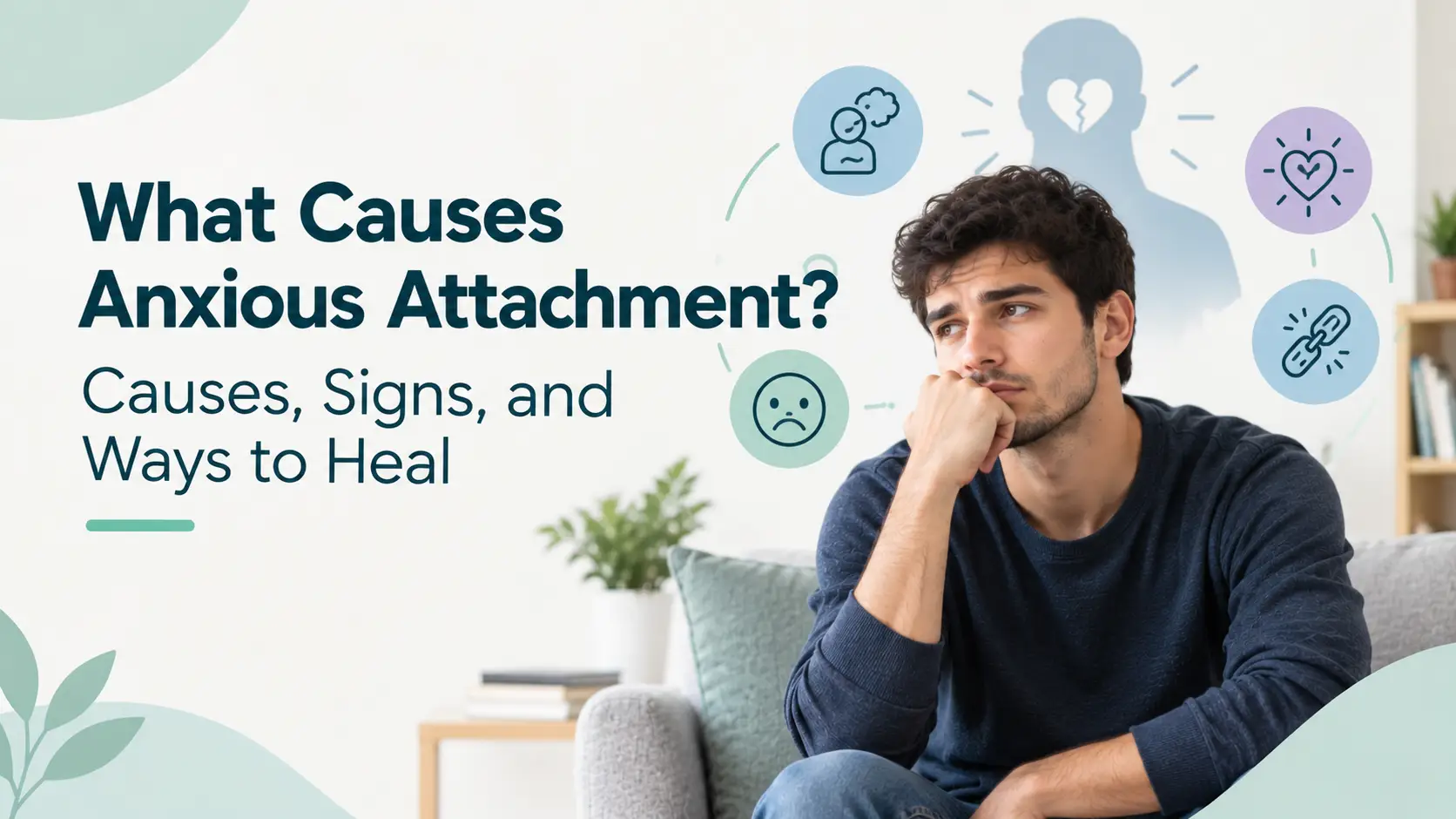
Anxious attachment develops when early relationships teach a child that emotional closeness is unpredictable or difficult to rely on. The most established cause is inconsistent caregiving, especially when caregivers respond warmly at some times and remain unavailable, distracted, or emotionally mismatched at others. Childhood experiences can shape expectations about trust, rejection, and emotional safety, but attachment patterns can change through awareness, supportive relationships, and therapy.
Urise Counselling can help you understand attachment wounds, relationship anxiety, and repeated emotional patterns. Understanding anxious attachment style causes and treatment can help you replace fear-driven reactions with healthier communication, self-validation, and boundary setting.
What Is Anxious Attachment?
Anxious attachment is an insecure attachment pattern marked by a strong desire for closeness and persistent fear of rejection or abandonment. Anxious-preoccupied attachment is the adult term commonly used for this pattern, while anxious ambivalent attachment describes a related childhood pattern.
Attachment Theory explains how early relationships with caregivers influence expectations about connection and support. Secure attachment develops when a caregiver responds consistently enough to a child’s needs. Insecure attachment can develop when care feels unpredictable, unavailable, intrusive, or unsafe.
An anxious attachment style is not a mental disorder or a personal weakness. Attachment patterns describe relationship tendencies, and a person can show different patterns across relationships and life stages.
What Causes Anxious Attachment?
Inconsistent caregiving is the central developmental factor associated with anxious attachment. A child may receive comfort and attention at one time but experience emotional distance or poor responsiveness at another time. Unpredictability makes it difficult for the child to form stable expectations about whether support will be available.
Several experiences can contribute to this pattern:
- Inconsistent parenting can make emotional responses difficult to predict.
- Emotional neglect can leave a child without reliable emotional validation.
- Conditional love can teach a child that love must be earned through behavior or compliance.
- Family conflict can make relationships feel unstable or unsafe.
- Early separation from a caregiver can disrupt a child’s expectation of reliable connection.
- Trauma can affect trust, emotional regulation, and perceived safety.
- Parental anxiety can affect how a caregiver responds to a child’s distress.
- Overprotective or intrusive caregiving can limit confidence in independent coping.
These factors do not produce the same outcome in every child. Temperament, family circumstances, other supportive relationships, and later experiences can influence attachment development.
How Does Anxious Attachment Develop in Childhood?
Anxious attachment develops when a child repeatedly experiences uncertainty about whether a caregiver will respond to emotional needs. A child may learn to monitor facial expressions, tone, availability, and mood closely because anticipating the caregiver’s response becomes important for obtaining comfort.
This pattern can encourage heightened emotional signaling and persistent proximity-seeking. The child is not deliberately manipulating the caregiver. The behavior reflects an attempt to maintain connection and obtain predictable care.
Intergenerational patterns can contribute when adults repeat relationship behaviors learned in their own childhoods. A caregiver’s anxious behavior does not guarantee anxious attachment in a child, but repeated relational patterns can influence the child’s expectations.
What Are the Signs of Anxious Attachment in Adults?
Common signs include fear of abandonment, frequent reassurance-seeking, relationship preoccupation, and strong sensitivity to perceived rejection. Signs of anxious attachment in adults can appear in romantic relationships, friendships, and family relationships.
You may notice:
- Frequent worry that a partner will leave or lose interest.
- A strong need for reassurance and validation.
- Distress when messages receive delayed replies.
- Clinginess or difficulty tolerating emotional distance.
- Jealousy or possessiveness when attention shifts elsewhere.
- People-pleasing to prevent conflict or rejection.
- Difficulty setting healthy boundaries.
- Low self-esteem or negative self-worth.
- Rumination and overthinking after relationship interactions.
- Catastrophizing about separation, conflict, or changes in affection.
- Difficulty feeling emotionally secure when alone.
A single behavior does not establish an attachment style. An anxious attachment test can provide a starting point for self-reflection, but a questionnaire cannot diagnose a mental health condition or determine your complete relationship pattern.
How Does Anxious Attachment Affect Relationships?
Anxious attachment can create relationship anxiety because ordinary changes in closeness may be interpreted as rejection or loss of interest. A delayed message, canceled plan, or quieter conversation can trigger fear of abandonment even when the situation has another explanation.
Reassurance-seeking may temporarily reduce anxiety, but repeated requests for confirmation can create pressure within a relationship and contribute to communication issues in relationships. Fear can then produce checking, questioning, jealousy, or conflict. A partner may respond by withdrawing, which can intensify the anxious person’s fear.
This pattern can contribute to the anxious avoidant trap. One person seeks greater closeness when anxiety rises, while a partner with avoidant attachment seeks more distance when emotional pressure rises. Each response can reinforce the other person’s insecurity.
Healthy relationships require emotional safety, direct communication, mutual respect, and boundaries, which can be explored through couples therapy when relationship patterns become difficult to manage. Attachment patterns influence relationships, but attachment patterns do not determine whether a relationship will succeed.
What Triggers Anxious Attachment?
Anxious attachment triggers are situations that activate fears of rejection, abandonment, or reduced emotional connection. Common triggers include delayed communication, canceled plans, changes in routine, reduced affection, criticism, conflict, separation, and uncertainty about relationship status.
A trigger can produce rapid emotional reactions because the present situation may activate expectations formed through earlier experiences. The first step toward change is recognizing the trigger before acting on the emotional response.
Keep a journal that records the situation, thought, emotion, body sensation, and response. This practice can reveal whether specific events consistently activate relationship anxiety and whether your interpretation matches the available evidence.
How to Heal Anxious Attachment Style
To heal anxious attachment style patterns, develop emotional regulation, self-trust, secure communication, and healthier relationship boundaries. Healing anxious attachment takes time, self-awareness, and consistent effort. Professional support can help you work through deeper patterns and develop healthier ways of relating.
1. Build Self-Awareness
Self-awareness helps you recognize attachment triggers before anxiety controls your behavior. Notice what happened, what you assumed, what you felt, and what action you wanted to take. This process separates an emotional alarm from an established fact.
2. Practice Self-Soothing
Self-soothing helps you manage distress without depending on immediate reassurance from another person. Try slow deep breathing, grounding techniques, progressive muscle relaxation, journaling, or a brief walk. These practices can lower emotional arousal and create space for thoughtful communication.
3. Challenge Catastrophic Thoughts
Cognitive reappraisal helps you question worst-case interpretations and consider evidence-based alternatives. Ask what facts support your fear, what facts do not support the fear, and what explanation could reasonably fit the situation. This approach can reduce rumination and catastrophizing.
4. Strengthen Self-Validation
Self-validation means acknowledging your feelings without requiring another person to prove that your feelings are legitimate. Tell yourself that fear can feel intense without making the feared outcome certain. Positive self-talk can reinforce self-worth and reduce dependence on external validation.
5. Set Healthy Boundaries
Boundary setting protects emotional safety by defining what you need, what you accept, and what you will do when a limit is crossed. Practice saying no without excessive explanation and communicate relationship needs directly rather than using withdrawal, testing, or repeated reassurance-seeking.
6. Build a Secure Life Outside One Relationship
Secure attachment becomes easier to practice when your emotional life includes friendships, family connections, interests, work, and personal goals. A broader support system reduces pressure on one relationship to meet every emotional need and supports independence without requiring emotional isolation.
7. Communicate Needs Clearly
Direct communication replaces fear-driven testing with specific requests. Instead of accusing a partner of not caring after a delayed response, explain the need for predictable communication and discuss a practical arrangement together. Clear requests give both people useful information without escalating conflict.
8. Consider Therapy
Therapy can address attachment wounds, relationship anxiety, and emotional dysregulation at a deeper level than self-help alone. Attachment-based therapy can explore childhood experiences and current relationship patterns. Cognitive Behavioral Therapy (CBT) can address catastrophic thoughts, reassurance cycles, and negative beliefs about self-worth.
A therapist can help you develop nervous system regulation, self-validation, communication skills, and secure relationship behaviors. Therapy does not require proving that a caregiver was intentionally harmful. The focus remains on understanding learned patterns and improving present functioning.
Can Attachment Styles Change?
Yes, attachment styles can change. Attachment patterns are not permanent personality labels, and later relationships and therapeutic experiences can influence how you understand closeness, separation, trust, and emotional safety.
Change requires repeated experiences of healthy connection and repeated practice of new responses. You may still experience fear of abandonment after developing greater security, but the fear can become easier to recognize and manage without controlling your behavior.
Secure relationships can provide opportunities to experience consistent communication and boundaries. Therapy can provide another structured relationship in which you can examine attachment patterns safely and learn alternative responses.
Anxious Attachment vs. Other Attachment Styles
Anxious attachment prioritizes closeness while carrying a strong fear of rejection or abandonment. Secure attachment generally allows comfort with intimacy and independence. Avoidant attachment often involves greater discomfort with dependence or emotional closeness. Fearful-avoidant attachment combines a desire for connection with fear of intimacy or vulnerability.
These categories help describe patterns, not fixed identities. A person can show different attachment responses depending on the relationship, circumstances, and personal history.
When Should You Seek Professional Support?
Consider professional support when attachment-related anxiety repeatedly disrupts relationships, work, sleep, self-care, or daily functioning. Therapy is particularly appropriate when trauma, severe emotional dysregulation, persistent anxiety or depression, substance misuse, or repeated unhealthy relationships accompany attachment concerns.
A mental health professional can help determine whether attachment patterns explain your concerns or whether another condition requires attention. Professional assessment is more reliable than using an anxious attachment test alone.
Healing anxious attachment does not mean becoming less caring or less connected. It means developing enough emotional regulation and self-worth to tolerate uncertainty, communicate needs, respect boundaries, and maintain connection without constant fear.
Is Anxious Attachment the Same as Codependency?
No, anxious attachment and codependency are related but not interchangeable concepts. Anxious attachment describes expectations and behaviors around closeness, rejection, and abandonment. Codependency can involve excessive emotional reliance, difficulty maintaining boundaries, or prioritizing another person’s needs at the expense of personal wellbeing.
A person can experience anxious attachment without codependency. Likewise, codependent behaviors can occur without an anxious attachment pattern. Accurate assessment requires attention to relationship history, current behavior, and emotional functioning.
What an Anxious Attachment Test Can Tell You
An anxious attachment test can identify relationship tendencies, but a test cannot provide a clinical diagnosis. Useful questionnaires examine reassurance-seeking, fear of abandonment, comfort with independence, trust, communication, and reactions to emotional distance.
Use test results as prompts for reflection rather than definitive labels. A therapist can provide fuller assessment and help distinguish attachment patterns from anxiety, trauma responses, or other mental health concerns.
What Healing Actually Looks Like
Healing means responding to attachment triggers with greater flexibility rather than never feeling attachment anxiety again. Progress can include tolerating a delayed response without repeated checking, expressing a need without accusation, setting a boundary without excessive guilt, and spending time alone without assuming abandonment.
Progress is measured through changed responses, stronger self-worth, healthier boundaries, and greater emotional safety. Occasional anxiety does not mean that healing has failed. Attachment patterns influence relationships, but understanding these patterns can be useful when considering relationship therapy for a healthier partnership.
Frequently Asked Questions
Can childhood experiences contribute to anxious attachment?
Yes, childhood experiences can contribute to anxious attachment, particularly when caregiving is inconsistent, unpredictable, emotionally unavailable, or intrusive. Emotional neglect, conditional love, family conflict, trauma, and early separation can affect expectations about trust, support, rejection, and emotional safety.
What are the common triggers of anxious attachment?
Common triggers include delayed messages, canceled plans, emotional distance, criticism, conflict, separation, reduced affection, and uncertainty about relationship status. These situations can activate fear of abandonment and lead to reassurance-seeking, rumination, jealousy, catastrophizing, or attempts to restore closeness.
Can past relationship experiences cause anxious attachment?
Yes, painful relationship experiences can strengthen anxious attachment patterns, especially after rejection, betrayal, abandonment, or unstable relationships. Later experiences do not necessarily create the original childhood pattern, but repeated insecurity can reinforce fear-based expectations and relationship behaviors.
How can anxious attachment be managed?
Anxious attachment can be managed through emotional regulation, self-soothing, cognitive reappraisal, self-validation, healthy boundaries, clear communication, and therapy. Journaling can identify triggers, while professional support can address attachment wounds, trauma, relationship anxiety, and persistent emotional dysregulation.